CT or MRI? Which Scan Your Pet Might Need
When a dog or cat comes in for a neurological problem, we do not start with machines. We start with the pet and their owner. What have you noticed at home? When did it begin? What does it look like? Nobody knows your pet better than you do, and that conversation — combined with a thorough physical examination — is where every diagnosis begins.
Before any imaging is ordered, a neurologist carefully observes how the animal moves, how they respond to touch, and whether their reflexes are normal. The goal is to figure out where in the nervous system the problem is coming from — the brain, the neck, the back, or somewhere else. That answer guides everything that follows, including which imaging tool makes the most sense.
The nervous system presents a unique challenge when it comes to imaging. The brain and spinal cord are surrounded entirely by bone. Standard X-rays and ultrasound cannot see through that bony protection to the soft tissue inside. So we rely on a different kind of imaging — one that can look at the body in detailed cross-sections. There are two options: CT and MRI.
What Is a CT Scan?
Most people have heard of a CT scan, sometimes called a CAT scan. It uses X-ray technology to create detailed images by looking at the body from many angles at once. Because it reads differences in tissue density, CT is excellent at showing bone. It is fast, and it is particularly useful when trauma or a bone injury is suspected.
For the brain and spinal cord, however, CT has real limitations. Those structures are soft tissue, and CT does not see soft tissue nearly as well as it sees bone. Getting a clear picture of the spinal cord with CT requires injecting contrast material directly around it, a procedure that carries some risk. CT also uses radiation, which is worth considering with repeated scans.
At The Animal Neurology Center, CT is part of our diagnostic toolkit. It is:
- Useful when we need to evaluate bony structures in detail
- Particularly advantageous in enabling us to plan for 3D printing to optimize our surgical results
- Enables us to look at the accuracy and safety of the metal implants we’ve placed, which are hard to see on MRI.
What Is an MRI?
MRI — magnetic resonance imaging — is the gold standard for imaging the brain and spinal cord, in both human and veterinary medicine. Where CT reads density, MRI reads water content in the body’s tissues. That difference allows it to produce extraordinarily detailed images of soft tissue structures like the brain, spinal cord, and intervertebral discs — detail that CT simply cannot provide.
For most neurological conditions, including disc disease, brain tumors, and inflammatory disease, MRI gives us the clearest picture of what is happening and where. It does not use radiation, and it does not require injecting contrast around the spinal cord. It takes a little longer than CT and requires anesthesia, but the quality of information it provides is unmatched.
The ANC’s MRI: A First in Veterinary Medicine
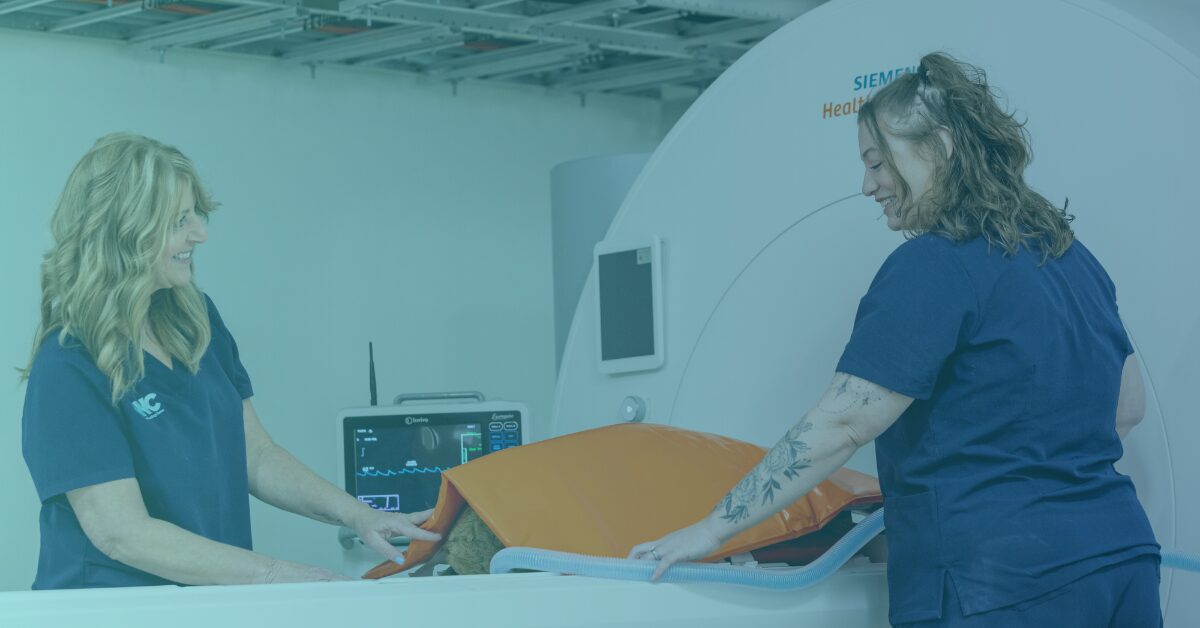
The Animal Neurology Center is proud to be the first veterinary facility in the United States to install the Siemens Healthineers Magnetom Flow.Ace — a 1.5 Tesla MRI system that until now has only been available in human hospitals.
What that means practically for your pet: faster scan times, less time under anesthesia, and image quality that has historically only been available to human patients. The system uses AI-powered imaging technology that produces clearer, more detailed results than conventional veterinary MRI equipment.
When this system was installed in late 2025, The ANC’s owner Dr. Fred Wininger noted that it has exceeded every expectation — delivering high-quality images with shorter scan times, while also supporting a commitment to environmental sustainability. For pets in the St. Louis region, it means access to the very best diagnostic imaging available anywhere in veterinary medicine today.
The Right Tool for the Right Question
CT and MRI are not competing with each other. They answer different questions. CT is faster and better for bone. MRI is more detailed and better for the brain and spinal cord. Having both available means we can choose based on what each individual patient needs — not based on what is available.
When to Seek Help
If your pet is showing signs that something may be wrong neurologically — weakness, stumbling, pain, sudden changes in behavior — start with your primary veterinarian. They can help determine whether a specialist referral makes sense.
At The Animal Neurology Center, our goal is simple: find the answer as accurately and efficiently as possible, and use it to help your pet feel better. Advanced imaging is one of the most powerful tools we have to do that. We are proud to offer the best of it right here in St. Louis.